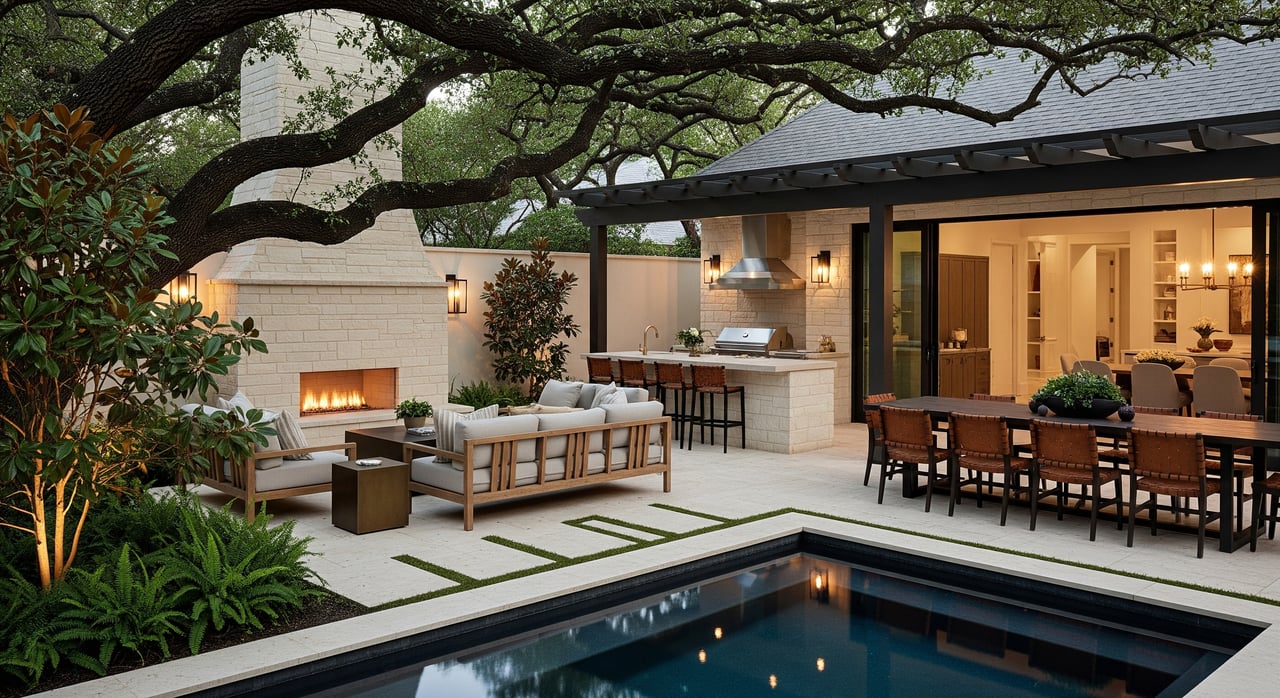
Have a beautiful tree canopy but a yard that feels dark, damp, or underused? You are not alone in Memorial. Mature live oaks, magnolias, and elms are a gift, but they change how you plan patios, structures, and lighting. In this guide, you will learn how to shape outdoor rooms that fit Houston’s climate, protect your trees, manage water, and look great in photos all year. Let’s dive in.
What Memorial’s shade means for design
Houston sits in a humid subtropical climate with long, hot summers and mild winters. Average annual rainfall is roughly 49 to 50 inches, often in short, heavy bursts. That means your outdoor spaces need to drain well, breathe in humidity, and handle occasional storms.
Houston’s USDA Plant Hardiness Zones are about 9a to 9b, so shade plant choices should be heat tolerant and adapted to mild winters. In west Houston and Memorial, soils are often clayey or mixed, which drain slowly. Some properties are near local floodplains, so include an overflow plan even when you design for infiltration.
Memorial’s mature canopy is a defining asset. Large trees have wide surface roots and sensitive driplines. Your design should protect those roots, minimize excavation near trunks, and avoid attaching structures to living trees. Freestanding elements that work with the shade will serve you best.
Pergolas that respect big trees
Choose freestanding, root‑friendly footings
Set pergolas outside critical root zones whenever possible. Where you must build nearby, use small‑footprint pier footings or helical piers to limit trenching and root loss. Work with a certified arborist to mark protection zones and with an engineer who understands local soils and root‑friendly foundations.
Keep equipment and storage outside the dripline during construction. Protective fencing and clear access paths help reduce soil compaction, which trees dislike. Plan pier locations after a site walk to confirm root flare and major surface roots.
Scale, materials, and roofs
Large trees call for taller, open pergolas that feel airy. An open‑lattice or raftered roof lets dappled light filter through, which suits Memorial’s canopy. If you want more control, adjustable louvered systems can temper sun and rain at added cost and maintenance.
For durability, consider rot‑resistant woods like cedar or cypress, thermally modified wood, or powder‑coated aluminum or steel. Dark finishes often photograph well against green foliage, while light wood adds warmth and contrast.
Placement and everyday use
Locate the pergola to capture your best view and to connect smoothly with existing doors or kitchens. Layout furniture early in the plan so post locations do not block sightlines. Leave room for circulation, and think about how the pergola frames photos at golden hour.
Permeable patios and paths
Best surface options for shaded lots
- Permeable interlocking concrete pavers for durable patios and walkways.
- Pervious concrete or porous asphalt for larger continuous surfaces with the right subbase.
- Gravel on a permeable base or resin‑bound aggregate for natural texture and good drainage.
- Reinforced grass or gravel pavers where occasional vehicle access is needed.
- Decomposed granite with binders for informal, shallow‑depth paths.
Choose surfaces that limit compaction near roots. Avoid heavy, rigid slabs close to trunks. Floating path sections or distributed small footings help reduce root cutting.
Subbase and drainage strategy
Clay soils may infiltrate slowly, so design for both absorption and overflow. Use a properly graded, open‑graded aggregate subbase sized to your soil tests. Add underdrains or an infiltration trench if needed, and direct overflow to a rain garden downslope from the patio.
Pair permeable hardscape with planting beds that soak up water through the year. Cisterns or rain barrels can capture roof runoff to support beds during summer heat.
Maintenance and long‑term performance
Permeable surfaces work best when joints and pores stay clear. Sweep or vacuum pavers periodically and recharge joint material as needed. After major leaf drop, remove debris so the surface keeps breathing and draining.
Lighting that glows, not glares
Dark‑sky principles at home
Aim light only where you need it. Use fully shielded fixtures to reduce glare and light scatter into the canopy. Choose warm LEDs in the 2700 to 3000 Kelvin range to keep nighttime comfortable and wildlife‑friendlier.
Layer your lighting for function and mood. Combine subtle pathway lights, low‑angle tree uplighting with shields, downlighting integrated into pergolas, and soft accents for focal plants or water features. Keep levels low for a calm, inviting feel instead of a bright wash.
Installation tips under a canopy
Run conduits away from major roots. Where possible, use shallow, narrow trenches or micro‑trenching methods to reduce disturbance. Select fixtures with appropriate ingress protection for Houston humidity and summer storms, and add timers, dimmers, and motion sensors to save energy and reduce unnecessary light.
Plants that thrive in deep shade
Structural shrubs and small trees
Consider shade‑tolerant options that add form and seasonal interest. Eastern redbud and American fringe tree provide texture and bloom in partial shade. Dwarf yaupon holly offers evergreen structure and neat forms along edges.
Oakleaf hydrangea, inkberry, and yaupon holly varieties make strong backbone plantings under the canopy. They create rhythm and depth that read well in photos.
Understory and groundcovers
For color and wildlife support, try Turk’s cap, foamflower, coral honeysuckle, and American beautyberry. Layer these with groundcovers like liriope, mondo grass, native ferns, and ajuga in wetter pockets.
Turf often struggles under deep shade. Use shade‑tolerant turf only where you have enough filtered light, or replace grass with layered beds and mulch. Keep mulch 2 to 3 inches deep and away from trunks.
What to skip
Avoid invasive or aggressive vines that can overrun trees. Be cautious about attaching anything to trunks. In heavy shade, limit thirstier, sun‑loving species that will decline over time.
Bring the sanctuary home
Take cues from nearby nature sanctuaries and parks. A layered understory, native shrubs, curving paths, and a small water feature create habitat and a quiet mood. Dense shrubs in select pockets encourage birds and beneficial insects while keeping maintenance manageable.
A single focal point helps the space read clearly. Choose a fire table, sculptural planter, or water bowl that anchors the seating area. Keep sightlines open to your most graceful trunks and branches.
A phased plan that works
Phase 0: Pre‑design
- Call 811 for utility locates and obtain a site survey if needed.
- Have a certified arborist assess tree health and root protection zones.
- Run basic percolation or infiltration testing to guide hardscape design.
- Confirm permits with the City of Houston for structures and electrical work, and check any floodplain considerations.
- Set photography goals and view corridors early so the layout frames your best angles.
Phase 1: Tree protection, drainage, groundwork (1 to 3 weeks)
- Install tree protection fencing and document existing conditions.
- Grade shallow swales or install infiltration trenches and route downspouts to future rain gardens or barrels.
- Prepare subgrade for permeable surfaces using minimal compaction techniques near root zones.
Phase 2: Structural elements and rough utilities (2 to 4 weeks)
- Install pier or helical footings and build the pergola.
- Lay permeable patio and path systems with proper edge restraints.
- Run conduits for low‑voltage lighting with root‑friendly routing.
Phase 3: Planting, finishes, and lighting (1 to 2 weeks)
- Plant trees, shrubs, and groundcovers in fall or spring for best establishment.
- Install fixtures, set timers and dimmers, and aim lights to avoid glare and spill.
- Place furniture and style the space for immediate use and strong photos.
Phase 4: Fine tuning and maintenance (ongoing)
- Monitor plants during the first 1 to 2 years, adjusting irrigation based on weather. Include a rain sensor or moisture‑based controller.
- Sweep and vacuum permeable surfaces annually; recharge paver joints as needed.
- Realign fixtures after storms and adjust timers seasonally. Schedule annual arborist checkups for pruning and tree health.
Photo‑ready finishes all year
Layer plant textures in the foreground, center your seating and focal point in the midground, and showcase the canopy in the background. This creates depth in photos and in person.
Use contrast to stand out against all that green. Warm woods, dark metal accents, and a few colorful textiles or containers add pop. Twilight photos are especially effective. Turn on low‑level ambient lights and subtle uplights to add sparkle without glare.
For seasonal interest, mix evergreen structure with a few bloomers for spring and fall, plus berrying plants like beautyberry or yaupon for winter color. Keep clutter out of the frame by planning hidden storage for hoses and tools.
Budget and value tips
Prioritize tree protection and drainage first. They prevent expensive fixes later.
Split the project into structural and aesthetic phases. Build the pergola, primary patio, and safety lighting first, then add decorative planting and furnishings.
Keep a contingency for unexpected root conflicts or soil remediation. It is common on mature, shaded lots.
Ready to plan your Memorial outdoor room?
With the right plan, your shaded lot can be the coolest place to be, even in a Houston summer. Protect your trees, keep water on site, and layer lighting and plants for year‑round appeal. If you are thinking about selling now or in the future, these upgrades also photograph beautifully and help your listing stand out.
Reach out to The Jennifer Ciulla Group for local guidance, market‑savvy preparation, and a clear plan to showcase your home. Get Your Free Home Valuation to see what strategic improvements could mean for your equity.
FAQs
What makes pergolas a good fit for Memorial’s shaded yards?
- Freestanding pergolas with open roofs add usable outdoor rooms without harming tree trunks or major roots, and they let dappled light pass through for comfort.
Which permeable patio surfaces work best on clay soils in Memorial?
- Permeable pavers, pervious concrete, and gravel on an open‑graded base all perform well when paired with the right subbase, edge restraints, and an overflow plan.
How warm should outdoor lights be under a canopy?
- Choose warm LEDs in the 2700 to 3000 Kelvin range, use fully shielded fixtures, and layer low‑level path, downlight, and accent lighting to reduce glare.
What plants handle deep shade in Houston’s Zones 9a–9b?
- Try Eastern redbud, American fringe tree, dwarf yaupon, oakleaf hydrangea, inkberry, Turk’s cap, foamflower, coral honeysuckle, beautyberry, and native ferns.
When is the best season to plant in Memorial’s climate?
- Plant in fall or spring so roots establish before peak summer heat or rare cold snaps, then mulch 2 to 3 inches and adjust irrigation as plants settle in.